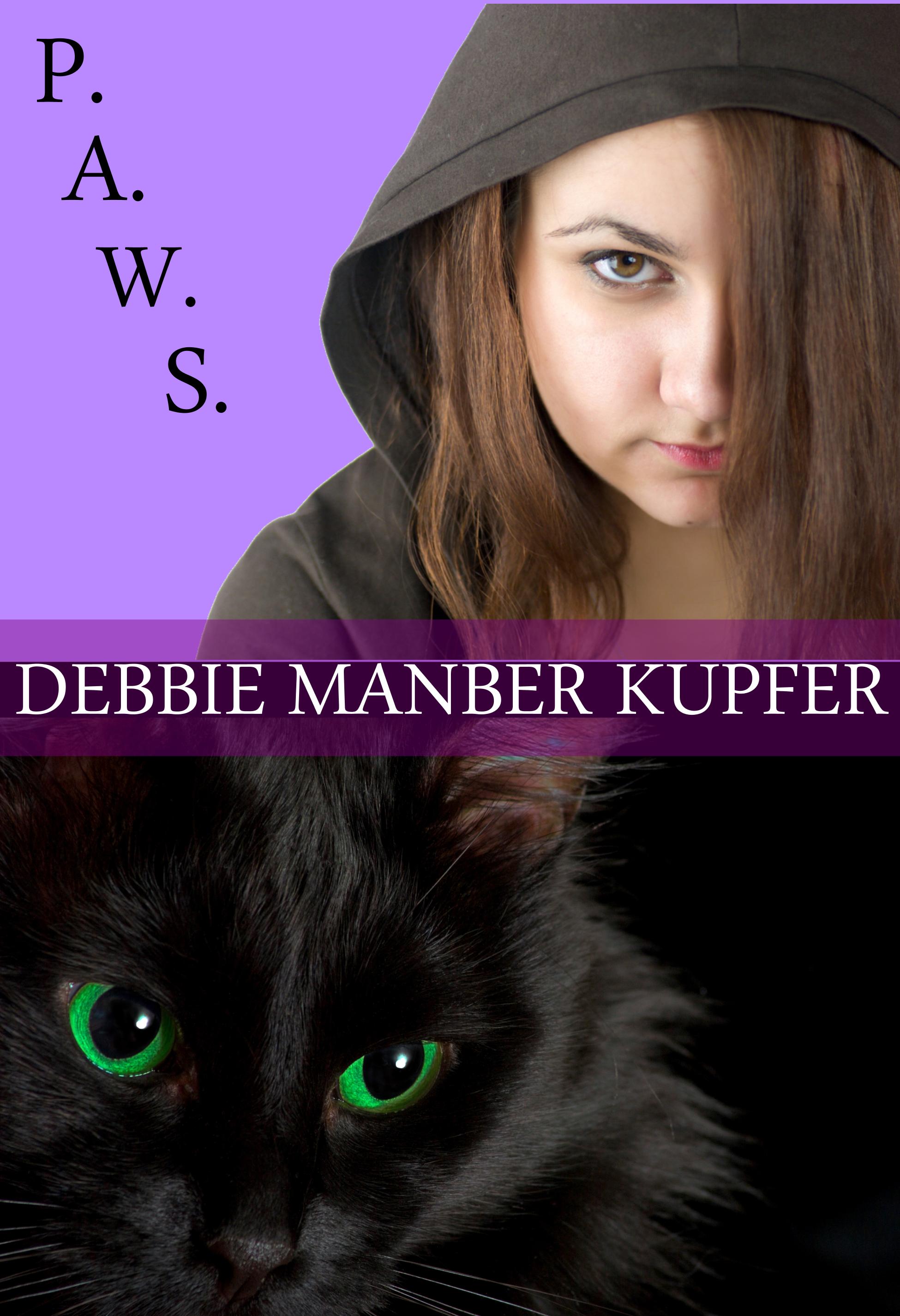
Today’s interview is with Debbie Manber Kupfer, author of the upcoming teen fantasy novel, P.A.W.S. RHP intern Melanie Whithaus posed these questions after reading the book:
Were the characters inspired by anyone you know personally?
Nearly all of the characters in P.A.W.S. have character traits of people I have known, but just a few I based directly on family members. Celia and Max are very similar to my own omama and opapa, who I was very close to growing up. Like Miri, my omama passed away when I was 10 years old. Though I didn’t receive any cat charms from my omama, I did receive many stories about her life in Vienna and London and about her cats, Kitty and Suzy. She also taught me to bake – though I have never been able to replicate the wonders of her sponge cake.
I wrote the character of Joey, the kangaroo Animagus, especially for my son Joey who shares a lot of the character’s traits – both are always enthusiastic and bouncing from place to place with a never-ending appetite for learning new things.
What inspired you to write PAWS?
Ever since I read the third Harry Potter book, The Prisoner of Azkaban, I’ve been fascinated with Animagi. I wondered what it would feel like to become a creature and how a person would go about the transition. I also knew without a doubt that my animal form would be that of a cat. It was why I chose “Paws” for my puzzle nom. (In the puzzle community it is common for constructors to choose pennames or noms that represent something special in their lives.)
Miri’s story came to me in a flash and I’m indebted to my daughter and to the folks at NaNoWriMo (National Novel Writing Month) for encouraging me to write it.
Miri and her family are from Austria and were victims of the Holocaust. Does this have any significance to your own family history?
My father left Vienna when he was just six-years-old. He was brought to England with other child refugees on a program called the Kindertransport. He was extremely fortunate that both his parents were later able to join him. Many of his other family members were not so lucky. Thus I grew up with a small tight-knit family and only recently have begun to discover the names and histories of those who were left behind in Austria.
Do you own any cats and do you think they’re part of a secret society?
Yes, we have one very opinionated feline who, while I have no clear evidence that she is active in any secret society, has managed to gain control of our household.
What happened to Lilith in her past?
That is something we will discover in future books and something that Lilith herself needs to come to terms with before she can share her story.
The book is left opened with the potential for a sequel. Do you plan to write more PAWS? If so, what? Or if not, what does your writing have in store for us in the near future?
Definitely – there will be sequels! I have a whole world inside my head and I know already where it is ultimately going to lead, though I’m sure my characters will take me on journeys I cannot even envision at this time. I am excited to embark on those journeys and hope you will join me.
P.A.W.S. is available for pre-order now, and will be released on June 22 at a launch party at All on the Same Page Bookstore, 1:00-3:00 p.m.
“When Miri’s grandmother dies, she takes with her the family secret. Miri finds herself alone and abandoned in a St. Louis boarding school. But she is about to discover the secret isn’t dead.
“Taunted by bullies, Miri is shocked to learn she possesses a secret power. It can save her… but can it save those she loves? After she is befriended by others with the same strange, magical powers, her history comes alive. And with it, Miri’s fate becomes more dangerous.
“Join Miri on a mysterious and supernatural journey with her new friends, members of an underground St. Louis society known as the Partnership for Animagi, Werewolves, and Shapeshifters, better known as P.A.W.S.”
 Robin Writes