Winding Up the Season


Normally, I could talk about baseball season, but we all know where that’s going. Has gone. Barely started. Whatever. Shut up, Laura!

As I say every year, “Thank God that’s over with!” And again, not baseball, but gardening season. By September, I’m done. When my husband says, “I think I see a cucumber,” I do my best to convince him that he’s lost his mind and they’re just a figment of his imagination.

I start planting in mid-March, when the peas go in the ground and the tomato and pepper seeds are started in the greenhouse. Just so you don’t have to do the math, that’s six months of tilling, weeding, mulching, planting, tending, harvesting, and processing. And while I certainly enjoy it, that’s a long time for daily hard labor—no taking off for holidays or weekends, no 9-to-5.

There are still a few green bean plants, and all my peppers, and some straggly tomato plants still sort of producing, but really, they could kick off at any time and it wouldn’t bother me at all. In October, we’ll be mowing down what’s left, plowing it all under, and spreading manure. That will sit until February, when we spread more, and plow that under too.

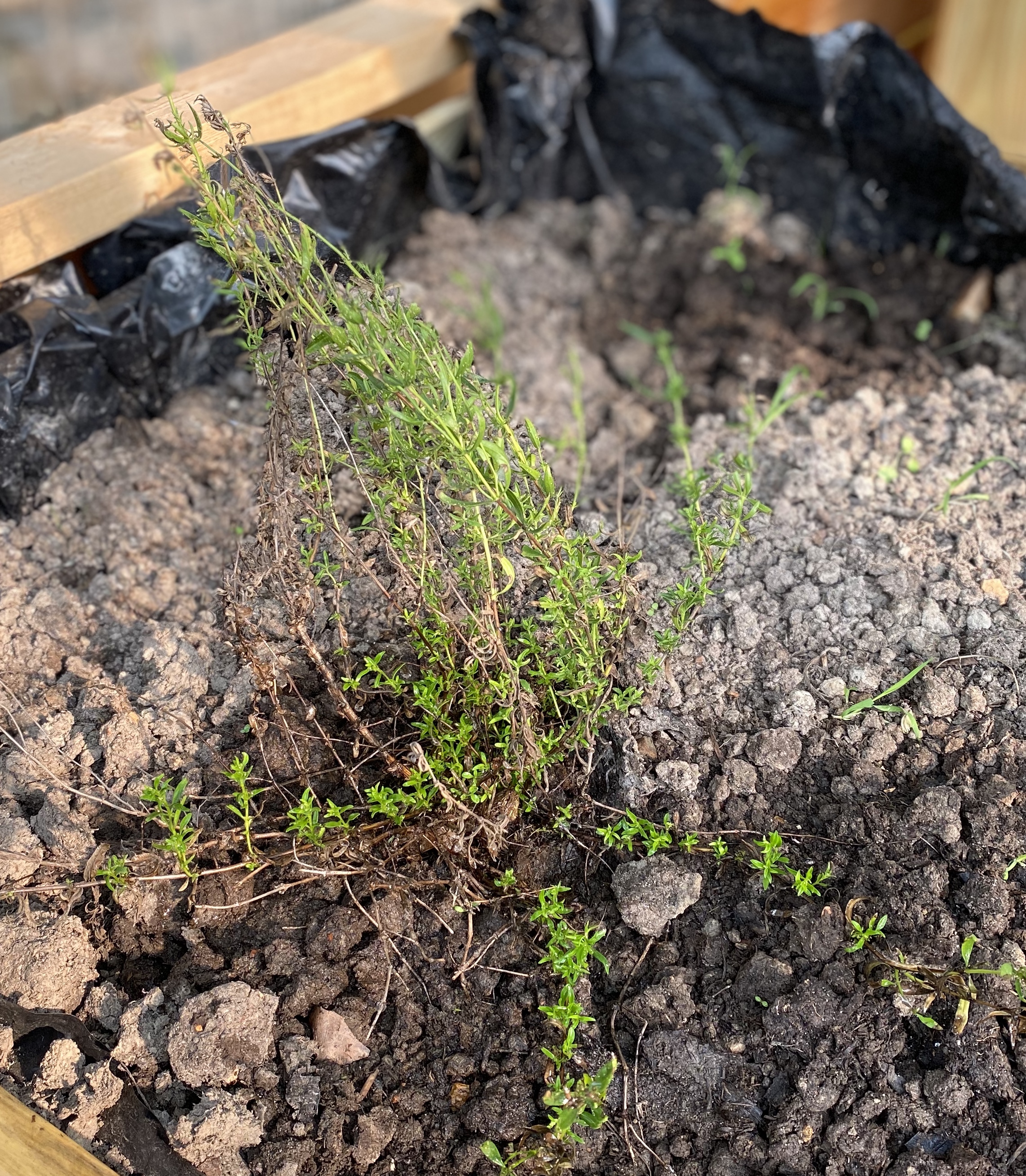
This year will be a little different, as I’m growing year-round now. My husband built this fabulous 24X14 greenhouse to replace the much smaller plastic-covered one I used for almost five years, mostly to start seed in the spring.

Now I’ve got grow lights, a rain barrel/pump watering system, elevated beds, and a work table. I’ll overwinter my outdoor container flowers, although some won’t make it, start next year’s baskets, and do a few experiments.

I know that many, many things are grown in greenhouses, and theoretically almost all vegetables and fruits can be done that way, but what I want to learn is whether or not *I* can do it.

Experiment #1: Garlic. I’ve been growing garlic in the ground for a few years, but my bulbs are consistently small. In the interests of improving them, I have some planted in the greenhouse. Because garlic takes a notoriously long time to grow, I also have half a row in the garden; September 1 is when I usually plant.

Experiment #2: Onions. Never managed to grow these, or if I did, they got lost in the weeds and accidentally pulled. In the elevated beds, I can actually see them, hence the experiment. Last year, I found an onion in the back of the pantry, nicely sprouted. I stuck it in the ground. Lo and behold, I grew five small onions! And by small, well…kind of like those garlic bulbs. But I didn’t really know what I was doing, never having brought any to that level of maturity, so I figured, why not? I planted those little things in the greenhouse—and they’re sprouting!

Naturally, there’s another side to this story. When I ordered fall/winter/greenhouse seeds, I figured I’d get a jump on next spring too and ordered everything but potatoes and green beans (sold out). About a week after they arrived, I saw sprouts coming out of the bag. Oops! Since I didn’t want to waste them, I read up on overwintering onions in the ground, like you do with garlic, and I planted a row. Still had onions. Planted a second section in the greenhouse and labeled it “more onions.” Still had onions. Planted a third section, labeled “more freakin’ onions.” Good thing we like onions!

Experiment #3: Green onions. Guess I’m a glutton for punishment. These aren’t, strictly speaking, an experiment. I grow them every years, chop and freeze, and we have green onions for a year from a 15+ foot row. This year, I got nothing. So the experiment is figuring out what went wrong.

Experiments #4 and #5: These two, iceberg lettuce and cabbage, are related—I can’t seem to get actual heads. I’ve grown Romaine for years, but we’re getting a little tired of it; besides, the dang stuff takes over and NEVER stops. Never.

Experiment #6: Eggplant. I’m not a huge fan of eggplant, but I do like it from time to time, and my husband just says, “Ick,” when I mention it, but I thought I’d see if I could grow some.

Experiment #7: Broccoli is not hard to grow, I’ve done it before in the garden. But let me tell you about worms… So, I grew broccoli, it was beautiful! I cooked the broccoli—and when I went to drain it, the water had these tiny white worms in it—GROSS. My stepmom told me to first soak it overnight in salt water, so I did, but picking out those dead worms was also disgusting, and it turned me off growing broccoli for, oh, seven years or so. But I’m going to try again, and keep my fingers crossed!

I have a few other experiments I’m trying, but haven’t planted them yet as the watering system will be getting some tweaks and upgrades later this week. Next time, I’ll fill you in on the rest of my greenhouse planting.

Confederates


Here’s the thing about Confederate monuments, whether they’re statues, buildings, whatever: they were erected and named in order to try to heal the country after a brutal civil war. States and counties and cities put up the statues and named the buildings—try to put yourself in the shoes of the losing side. To half the country, the Confederate monuments were honoring their heroes; many of those men were indeed heroic on the battlefield, regardless of their beliefs or yours.

I don’t think any one of them say “Here lies a great slaveowner.”

People are complicated. Each one of us does good things and bad things. It’s okay to remember the good and condemn the bad. That doesn’t mean you forget the bad.

And trying to ascribe modern thinking to the past will definitely muddle it up.

Comparing Confederates to Hitler is erroneous; Confederates fought in a war, Hitler tried to annihilate an entire people. Yes, it’s that simple.

You should, rightfully, believe that slavery was a terrible thing. Neither you nor I had one single thing to do with it, but yes, our ancestors did. Our ancestors. Not us.

Now, you can be angry, you can be enraged about the Civil War and how people used to think and believe and act, but you also can’t know what each of them were thinking or why they did what they did. Sure, there are still some letters and papers that give clues, but as for individuals, you just can’t know.

The Civil War split families and communities even then, yet here were are, doing the exact same thing. Having an air of superiority about your own beliefs and completely discounting others’ is wrong, no matter the subject.

Do you have kids? Aren’t there some things they’ve done that you’re proud of? Of course there are. What about things they’ve done or said that appalled you? Does that make you say, “Screw them, I hate them, they’re terrible children?” I seriously doubt it.

I’ve told my ancestor story before, but I’ll tell it again:

Once upon a time, a fourteen-year-old boy in Mississippi joined up to fight for the South; so did his three brothers and his father. They were sharecroppers; they owned no slaves. “States’ rights” was a rallying cry then, so maybe that’s why they fought. I don’t know, and neither do you.

Stanford Smith was captured in Arkansas. At some point, he escaped, and he was helped by another young teenage boy, a Yankee soldier. After the war, Stanford became a minister and married a young lady who reportedly had Indian blood. Some time later, that Yankee who helped him escape during the war, Jonathon Kirk, wrote to him about selling some horses; Jonathon and his son, Samuel, took a herd to Mississippi where Samuel fell in love with Stanford’s daughter. They married when she turned sixteen.

That, my friends, is the ultimate healing. No one bitched about a statue, no one burned down a building because of its name, but two families came together. And if they hadn’t, I wouldn’t be here, and neither would my cousins.

Even if I knew for sure that Stanford believed in slavery, I wouldn’t slash him from family history—he had his reasons, even if I don’t agree with them, whatever they were. I wouldn’t presume to speak for him, and, maybe the entire point is that he’s been dead for 111 years. Many, many things have changed since then.